
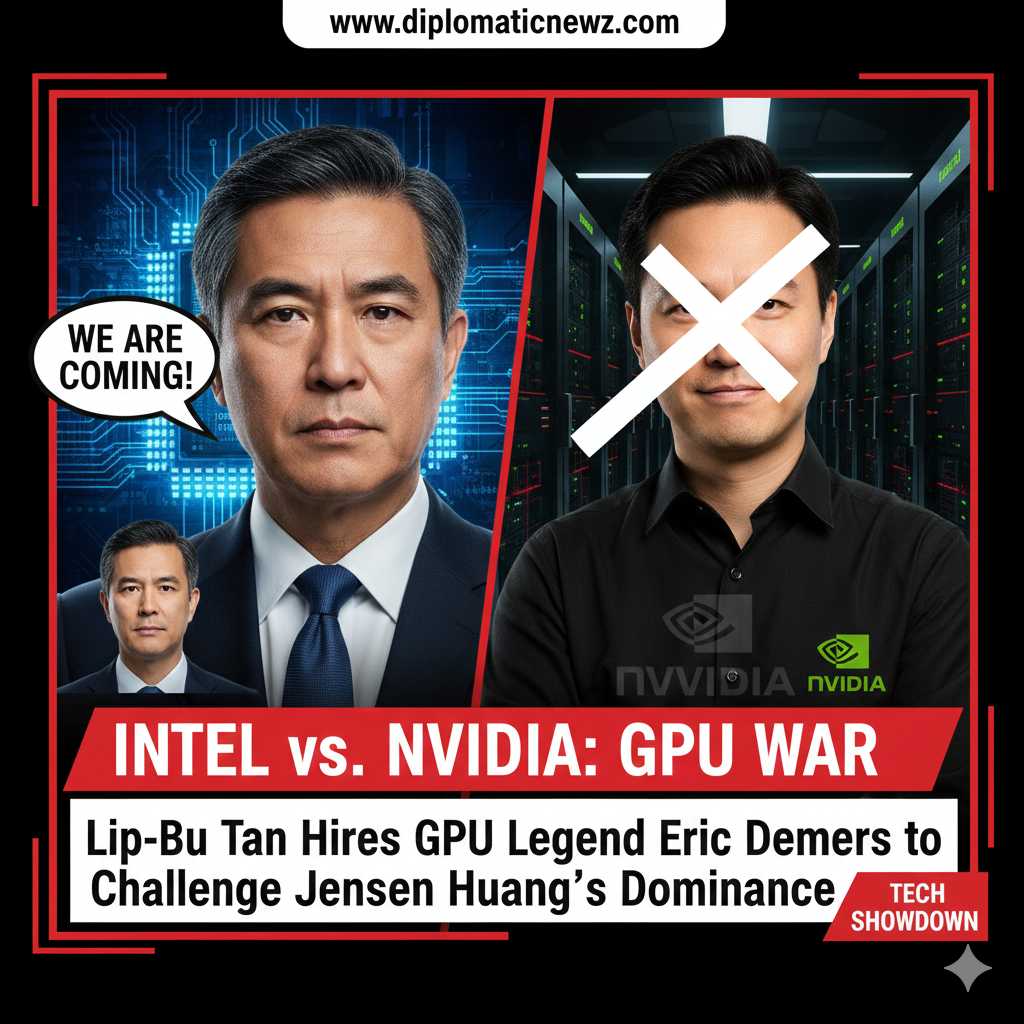

Intel Taps Ex Qualcomm AMD Engineer To Lead GPU Push Against Nvidia
San Francisco California. Tuesday February 4 2026. Tech
A bold move against Nvidia’s grip on the GPU world emerged Tuesday, when Intel’s chief executive Lip-Bu Tan revealed plans to dive deep into graphics chips during the Cisco AI Summit. Leading this push is Eric Demers – once engineering head at Qualcomm, with years shaping GPUs at AMD – who now joins Intel in a pivotal role. His arrival hints clearly: Intel means to stand tall where Jensen Huang’s company has long led. Not simply testing waters, but building momentum fast through seasoned expertise. This shift arrives quietly yet carries weight.
The Big Announcement: Intel’s GPU Ambitions
At the Cisco AI Summit in San Francisco, Intel’s chief Lip-Bu Tan spoke plainly. Questioned on GPU strategy, he responded without hesitation. The top graphics designer now works for him – recently brought onboard. His name came up often in elite tech circles. Pleased doesn’t begin to cover it, according to Tan. That hire? A clear signal of where Intel is headed
That top leader said bringing in the mystery hire – eventually named by several outlets as Eric Demers – took real persistence. A quiet nod from Tan suggested it wasn’t quick; his words light, but meaning heavy. Pulling off such a move meant tough talks behind closed doors. One of the sharpest names in graphics chips didn’t shift easily from Qualcomm’s side.
During a chat with Reuters at the event, Tan made clear Intel’s graphics chip push focuses on datacenters – precisely where Nvidia gained massive value from surging need for artificial intelligence hardware.
Who is Eric Demers? The GPU Architect Intel Just Recruited
Few names carry weight like Eric Demers when it comes to crafting graphics processors. Behind every major leap in GPU architecture over the past twenty years, his fingerprints are there. While others followed trends, he helped define them. A quiet force in a noisy field, his work speaks louder than titles ever could.
The AMD Years: Building Legendary GPUs
Last time around, Demers stayed close to ten years with AMD. He moved through different jobs there – some built around design, others about leading teams. That stretch saw him help shape several of the company’s top-performing GPUs. When it came to the R300 and later the R600 chip layouts, his input made a real difference. Those projects kept AMD within reach of Nvidia when competition heated up.
From a Design Manager role, Demers moved up – first leading the Architecture Team, then stepping into senior architect work by the time he left. Respect followed him through those years, built on sharp technical skill plus steady guidance when AMD’s GPUs were hitting their stride.
Qualcomm Dominance: Creating the Adreno Empire
Out the door at AMD, Demers landed at Qualcomm, staying close to fourteen years. Lately, he held the role of Senior Vice President of Engineering there. His time included steering the creation of Adreno GPUs, built by Qualcomm. That tech now powers most mobile device screens across the planet.
Starting under Demers, Adreno GPUs shifted from simple graphics helpers to powerful chips that handle intense games, AR tasks, and artificial intelligence functions inside phones and tablets. Because of his contributions, Qualcomm stayed ahead during tough battles with rivals like Apple, Samsung, and MediaTek in the mobile processor world.
Earlier Pioneering Work
Back then, before he landed roles at AMD and Qualcomm, Demers spent time at SGI and ArtX – firms that shaped the first wave of GPU design. These places laid groundwork now baked into today’s graphics chips. Ideas born there didn’t fade – they stuck around, quietly running inside newer systems.
Intel’s Strategic GPU Play
Reporting straight to Kevork Kechichian – Intel’s top executive overseeing Data Center and AI – the new role puts Demers at the core of strategic shifts. With that setup, one thing stands out clearly. The company isn’t aiming its GPU efforts at gamers or home users. Instead, attention lands firmly where profits are rising fastest: heavy-duty computing tasks inside corporate server farms powered by artificial intelligence.
“It’s tied in with the data center,” Tan told Reuters. “We’re working with customers, and will then define what the customer needs.”
Customer-Driven Development
Unlike traditional product development cycles, Tan emphasized that Intel’s GPU strategy will be driven by specific customer requirements. “In order to have a customer, they have to let us know what is the volume and which product, so that we can plan and take time to build the capacity,” he explained.
Starting here, talks between Intel and big tech firms hint at deeper planning around graphics processors. Not out of nowhere, these conversations come as Microsoft, Google, Amazon Web Services, and Meta hunt hard for options beyond Nvidia’s tight grip on artificial intelligence chips. With pressure building, stepping in now makes sense – timing matters more than it seems.
The Nvidia Challenge: David vs. Goliath?
Right now, Intel is pushing into graphics processors just as Nvidia holds nearly total control over artificial intelligence hardware used in data centers. Jensen Huang leads that firm, which owns roughly 80 to 90 percent of the chip market for training and running AI systems. Its H100 and H200 models sell at high costs, stuck in short supply because need keeps outpacing availability.
The AI Gold Rush
Picking up speed in the race for smarter machines, Graphics Processing Units now play a key role. Not built like regular chips from Intel, these parts handle many tasks at once without slowing down. While CPUs manage everyday computing jobs, GPUs push ahead where heavy number crunching is needed. Training systems such as ChatGPT, Claude, or Gemini leans hard on that power. Running thousands of calculations side by side makes the difference clear.
Now that’s what you call a spike in need. Boosted nearly all by chips for artificial intelligence, Nvidia brought in more than 47 billion dollars from datacenters during its 2024 financial year. Sitting above two trillion in value on the stock market, the firm stands among Earth’s priciest corporations.
Out of nowhere, rapid expansion brought chances – and pressure – for rivals to act fast. Big tech firms can afford top dollar for GPUs; still, relying only on one source feels risky. That gap lets real contenders step in – Intel sees its moment here. A chance like this does not come every day.
Intel’s Rocky GPU History: Lessons from Past Failures
Starting over in the datacenter GPU space, Intel is steering its direction after tough experiences from before. Earlier attempts had big goals; even so, results never matched the plan.
One wrong turn in production derailed what looked like a daring move – the Ponte Vecchio datacenter GPU leaned hard on cutting-edge chiplets and new ways to pack them together. Yet problems at the factory floor began piling up: too many chips failed, progress slowed. What followed? A string of missed deadlines that chipped away at trust. Most glaring, the Aurora supercomputer stumbled early, then dragged on for years without resolution. Doubt crept in. Could Intel really pull off massive GPU efforts when timelines kept breaking apart?
Off to a shaky start, Intel’s Gaudi chips didn’t catch on like hoped. Though expectations were high at first, yearly sales stayed below half a billion dollars – nowhere near what Nvidia pulls in from its data centers.
Fans of Arc gaming cards found them tough to recommend next to offerings from Nvidia or AMD. Praise went to cheaper versions, yet whispers said top-tier designs got scrapped – attention now sliding toward AI tasks and workstation duties. Plans changed, priorities shifted.
Why Eric Demers Is a Turning Point
Now stepping into Intel is Eric Demers – proof this GPU push isn’t just talk. Past attempts lacked his kind of track record: actually delivering graphics chips, again and again.
Picture this: Demers built Qualcomm’s Adreno GPUs, shaping chips that run efficiently and already ship in countless gadgets worldwide. Coming off work at AMD with speed-driven graphics, he then shifted toward smart, compact systems made for phones – a mix Intel now wants for boosting AI inside its big computing centers.
What stands out just as much is how closely he works with software builders, hardware makers, cloud platforms, and tech suppliers – these ties matter when putting together a group strong enough to take on Nvidia’s hold over CUDA.
Intel’s Broader Turnaround Strategy
Starting in March 2025, Lip-Bu Tan stepped in as CEO with a clear direction. His approach? Tighter operations, solid alliances – also proving Intel can still lead technically. The company’s new drive on graphics chips ties directly to that mission.
A surprise move saw the company team up with Nvidia, marked by a five-billion-dollar stake and joint work on artificial intelligence chips built for speed. Even so, where data center graphics processors are concerned, they still go head-to-head. Though aligned in certain goals, their rivalry holds firm in key tech arenas.
Federal support behind Intel runs deep – think a 10 percent ownership piece handed straight from Washington, plus heavy funding under the CHIPS law. That kind of commitment doesn’t happen without reason. It shows how tightly the company fits into America’s chipmaking plans at home.
Competitive Pressure and the China Factor
Fighting hard on several sides, Intel watches Nvidia stay ahead – thanks to strong chips and a powerful hold on software tools. While that plays out, AMD keeps making headway using its MI300 line to handle artificial intelligence tasks well enough to draw attention. Each move shifts the balance just slightly.
Meanwhile, chips built by new AI-focused companies along with custom designs from giant cloud firms are changing how things work. Though small at first glance, these players now push older models aside simply by doing one thing differently than before – quietly shifting what counts as powerful.
Out of nowhere, Tan pointed at China’s speed – how firms such as Huawei keep moving forward even when blocked. Without saying it straight, he made one thing obvious: resting now would be dangerous. Clever workarounds replace top-tier gear. Staying still? That luxury vanished.
The Road Ahead: Opportunity or Repeat History?
Fresh chips from Intel – shaped by shifting Xe designs, next-gen names such as Jaguar Shores, maybe even driven by 14A fabrication – might just hand the firm a real performance boost.
Hardware by itself falls short. What holds Intel back is how slowly software follows. Fifteen years ahead, Nvidia built something tough to catch – its CUDA base keeps growing while oneAPI lags behind.
Now things feel a little brighter, though care stays high. Shares climbed after recent gains, even if problems still hang around. Getting it right means showing up steadily – year after year – not just once. Building tools people rely on matters, along with proving they can count on what’s promised.
Truth sits clear now. Not pretending anymore, Intel shows up with strong leaders, deep pockets, stronger minds. A real player emerges – backed by more than talk. What happens next depends on results, not promises. Gaining ground in the marketplace will decide its place when AI shapes everything.
Key Takeaways
- Intel Plans Data Center GPUs to Challenge Nvidia
- Eric Demers joins as Chief GPU Architect following outreach efforts
- Demers with two decades of GPU experience including work on Qualcomm Adreno and AMD R300 R600
- Company targets ai infrastructure instead of gaming graphics cards
- Intel collaborates with datacenter clients on requirement definitions
- Demers reports to Kevork Kechichian who leads Intel’s Data Center and AI Group
- Out there, Nvidia holds 80 to 90 percent of the datacenter GPU space. Still, AMD begins to close the gap slowly
- Intel’s past GPUs struggled with performance and adoption
- In about 2026, a new method of making things should start being used more widely. This technique might begin full-scale work
- toward the year’s second half
- Intel struggles to match Nvidia’s software reach beyond hardware

 Juhi Ranna says:
  Joanna Riggs says:
  Gemma Marshall says:
  Joanna Holden says:
  Fallon Leggett says:
  Rishabh says:
  Lisa Mcclain says:

 By
By